Anxiety is one of the most common health concerns I see in my practice. In fact, according to Bandelow & Michaelis (2015), nearly one-third of people will experience an anxiety disorder at some point in their lives, with lifetime prevalence estimated at 33.7%.
Feeling anxious from time to time is a normal human response. Stressful life events, uncertainty, and major transitions can naturally bring up worry or fear. Anxiety becomes a problem when those feelings become overwhelming, don’t match the situation, or begin to interfere with daily life, especially sleep, focus, work, or relationships. Mild anxiety may feel like restlessness or unease, while more severe anxiety can be exhausting and debilitating.
Anxiety is a broad term that includes several related conditions. While each type looks a little different, they often share common symptoms such as persistent worry, nervousness, tension, and fear.
Generalized Anxiety Disorder (GAD)
- GAD involves ongoing, excessive worry about everyday things, often feeling “on edge” even when there’s no clear reason for concern (Zinbarg et al., 2023).
Social Anxiety Disorder (Social Phobia)
- It is marked by fear of being judged, embarrassed, or scrutinized in social situations, which may lead to avoidance and isolation (Zinbarg et al., 2023).
Panic Disorder
- It is defined by recurrent, unexpected panic attacks which are sudden urges of severe fear or discomfort with physical symptoms like shortness of breath, dizziness, and heart palpitations. This diagnosis has been documented as part of the major anxiety disorders in psychiatric research (Zinbarg et al., 2023).
Phobias
- Involve tense fear of specific objects or situations, such as heights, flying, or medical procedures, that disrupt daily life (Martin, 2003).
Obsessive -Compulsive Disorder
- It is characterized by intrusive thoughts and repetitive behaviors that drive significant anxiety and distress (Martin, 2003).
Post -Traumatic Disorder (PTSD)
- Post-Traumatic Disorder can develop after exposure to life-threatening or traumatic events, causing persistent anxiety, flashbacks, and emotional distress (Martin, 2003).
How Acupuncture Can Help?
A growing body of clinical research suggests that acupuncture can be a safe, non-pharmological approach to reducing anxiety symptoms, improving sleep, and supporting emotional well-being either alone or alongside conventional care.
Evidence from Clinical Research
A recent meta-analysis of randomized controlled trials found that acupuncture significantly reduces anxiety symptoms in people with generalized anxiety disorder compared with sham or controlled conditions, including improvements in anxiety severity, sleep quality, and mood scores. These results support acupuncture as a legitimate complementary option for anxiety relief (H. Jiang & Ma, 2025). Additionally, other systematic reviews show that acupuncture treatments over several weeks are generally well tolerated and associated with meaningful reductions in anxiety symptoms, reinforcing what many patients report in practice (X. Yang et al., 2021).
For trauma-related anxiety such as PTSD, recent clinical trials have specifically looked at acupuncture for veterans and other trauma populations, showing benefits in anxiety, sleep, and related symptoms compared with baseline measures (Hsiao et al., 2025)
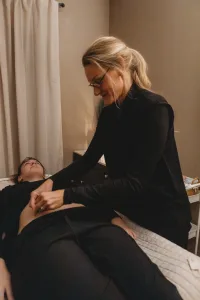
During your visit at Ageless Acupuncture, we’ll take a thorough look at your symptoms, lifestyle, and overall health. Using gentle, targeted acupuncture, we work to restore balance, reduce stress, and support your body’s natural ability to heal, so you can feel calmer and more resilient under the care of a licensed acupuncturist in Charleston.
References:
- Bandelow, B., & Michaelis, S. (2015). Epidemiology of anxiety disorders in the 21st century. Dialogues in clinical neuroscience, 17(3), 327–335. https://doi.org/10.31887/DCNS.2015.17.3/bbandelow
- Hsiao, A.-F., Lai-Trzebiatowski, J., Smith, T., Calloway, T., Aden, C., Jovanovic, T., Smith, B., Carrick, K., Munoz, A., Jung, M., & Hollifield, M. (2025). Acupuncture for Anxiety, Depression, and Sleep in Veterans with Combat-Related Posttraumatic Stress Disorder: A Randomized Controlled Trial. Journal of Clinical Medicine, 14(10), 3443. https://doi.org/10.3390/jcm14103443
- Jiang, H., Ma, R., Huang, Y., Li, X., & Hao, Y. (2025). Efficacy of acupuncture versus sham acupuncture on generalized anxiety disorder: a meta-analysis of randomized controlled trials. Frontiers in neurology, 16, 1682400. https://doi.org/10.3389/fneur.2025.1682400
- Martin P. (2003). The epidemiology of anxiety disorders: a review. Dialogues in clinical neuroscience, 5(3), 281–298. https://doi.org/10.31887/DCNS.2003.5.3/pmartin
- Yang, X. Y., Yang, N. B., Huang, F. F., Ren, S., & Li, Z. J. (2021). Effectiveness of acupuncture on anxiety disorder: a systematic review and meta-analysis of randomised controlled trials. Annals of general psychiatry, 20(1), 9. https://doi.org/10.1186/s12991-021-00327-5
- Zinbarg, R. E., Williams, A. L., Kramer, A. M., & Schmidt, M. R. (2023). Generalized Anxiety Disorder, Panic Disorder, Social Anxiety Disorder, and Specific Phobia. Oxford University Press EBooks, 147–180. https://doi.org/10.1093/med-psych/9780197542521.003.0007